The Captain You Booked

- Name
- Karan Prasad
You climbed on a stranger's bike yesterday. The system did not check his mind. A long look at the strangest blind spot in Indian transport, and why the obvious fix would make it worse.
You climbed on a stranger's bike yesterday.
You let him take you home through traffic at sixty kilometres an hour, on a vehicle with no cage, no airbag, no nothing between his decisions and your face. You did this twice. You'll do it again tomorrow. You don't know his name. You wouldn't recognise him in a lineup. You rated him five stars because he didn't kill you.
I've done this too. I do it constantly. So does almost everyone reading this.
Now think about something a bit strange.
In India, you cannot legally own a firearm without attesting to your mental fitness. You cannot fly a Boeing without a psychiatric evaluation. You cannot enter the armed forces without sitting through a five-day battery of psychological tests. Even truckers in the United States operate inside a federal psychiatric framework where a doctor can pull a licence on mental-health grounds.
The man steering you home tonight passed exactly none of those. He showed a driving licence. He showed his RC. He showed his Aadhaar. The app accepted him.
There was no check on his mind.
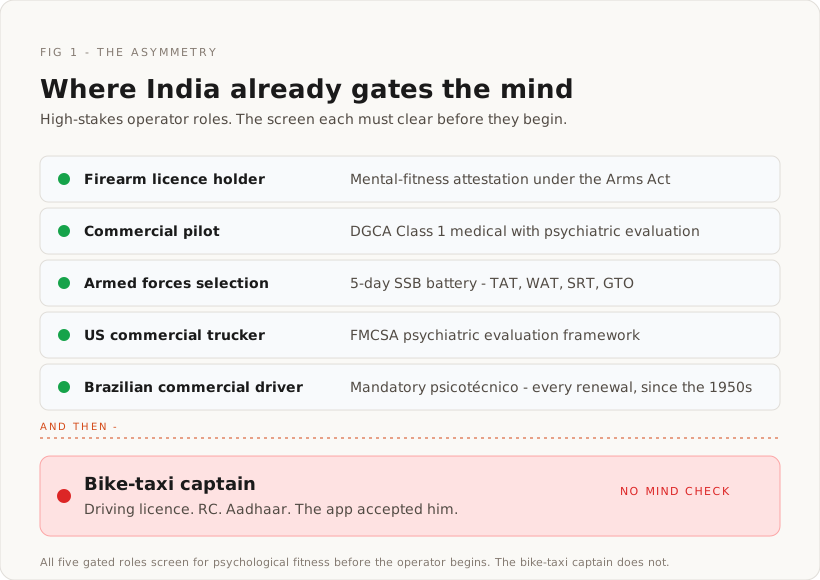
This is the gap I want to walk you into for the next ten minutes. It's wider, weirder, and more global than you'd expect. And the obvious fix - make all the captains take some kind of mental-health test before they ride - would, almost certainly, make things worse.
Two takes that both miss the point
Most people, hearing this for the first time, react with one of two takes.
The first take: "This is the platform's fault. They don't care, they're just optimising for supply, and a regulator should make them screen."
The second take: "This is the captain's responsibility. If he's not okay he shouldn't ride."
Both takes are intuitive. Both are wrong in interesting ways. To see why, you have to spend a minute inside his day, and inside the international evidence on what happens when this kind of screening actually gets built.
A minute inside the captain's day
A bike-taxi captain in Bengaluru opens his app at six. Surge is up. He hasn't eaten. He has loan EMIs to a man who knows where his wife stays. The app gives him a ride. He accepts. The price is ₹38. He is now thirty-two minutes from the customer. Petrol from his pocket. If he cancels, his acceptance rate drops, and the app punishes him on tomorrow's allocations.
He has been riding for nine hours when you book him.
This is not a job description. This is, in the language of occupational psychology, a stress profile - long hours, low control over scheduling, low pay, no peer community, ambient debt, and direct unshielded physical proximity to a stranger he must keep alive on a two-wheeler in chaotic traffic.
The 2024 Amoadu scoping review of commercial drivers worldwide - twenty-seven citations and counting - describes this exact configuration as the most reliable predictor of mental-health deterioration in driving work. A 2024 Indian study on gig workers reproduces the burnout signal locally, with the additional finding that being a married sole earner makes it considerably worse. A 2023 Korean study finds that gig workers face workplace violence and depressive symptoms at rates significantly higher than the general workforce. The All India Gig Workers Union, in a 2026 internal survey, reports that more than sixty percent of its members show symptoms of anxiety or depression.
You are not booking a man. You are booking a man inside a system that produces a specific kind of damage. The damage is reasonably well-documented in the academic literature. None of it is being measured at the gate.
The obvious fix, and why it isn't
Make them all take a mental-health test, the obvious fix says. Some kind of screen. A questionnaire. A clinical interview. Filter out the unstable ones at onboarding.
This is where it gets interesting. Because we have something close to a controlled experiment for what happens when you do that.
It is called Brazil.
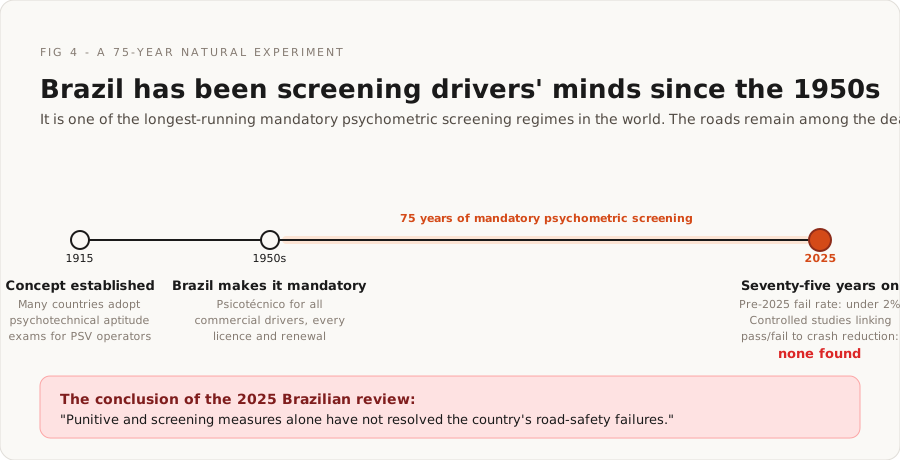
Brazil has been mandatorily psychometrically screening commercial drivers since at least the 1950s. Conceptually, the practice goes back to 1915. It is called the psicotécnico - a battery of attention, reaction time, judgement, and personality tests, administered by licensed traffic psychologists in state-authorised centres, capped by the federal government at R$180 a session. Every commercial driver, every renewal, for seventy-five years.
Brazilian roads remain among the deadliest in the world.
Search the Brazilian academic literature for a single controlled study linking psicotécnico pass-fail to subsequent crash rates among commercial drivers, and you will find none. A 2025 Brazilian review concludes that punitive and screening measures alone have not resolved the country's road-safety failures. The fail rate on the exam, before 2025, was under two percent - a number so low it suggests the system has degenerated into a rubber stamp.
A 75-year natural experiment in mandatory mental-fitness screening of commercial drivers exists. It is not the success story you'd expect.
The gold standard is in retreat
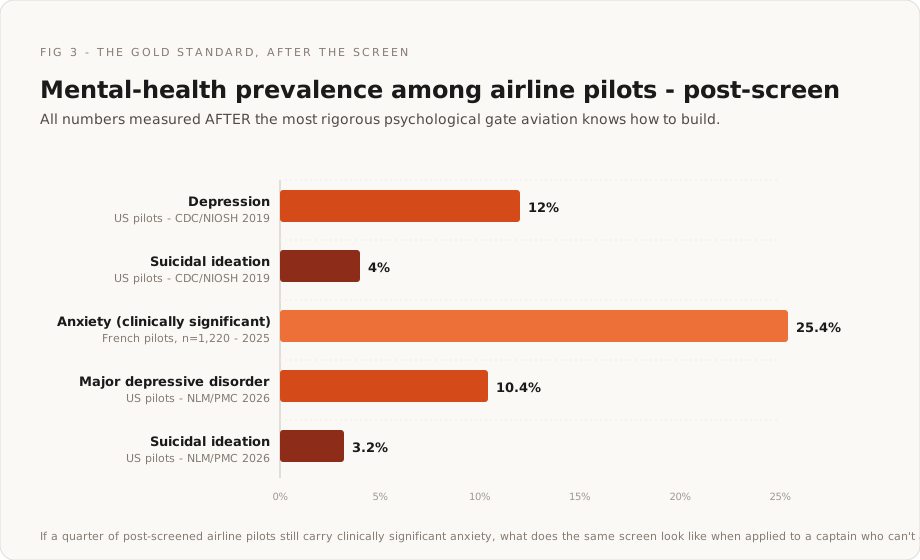
Now consider aviation, which is held up everywhere as the gold standard. The CDC and NIOSH ran a survey of active US airline pilots in 2019 - the most filtered, most regulated transport workforce on Earth, with annual medicals, designated aviation medical examiners, and continuous oversight. More than twelve percent met clinical criteria for depression. Four percent reported recent suicidal ideation.
A 2025 French study, 1,220 active pilots: 25.4 percent with clinically significant anxiety. A 2026 study from the US National Library of Medicine: 10.4 percent with major depressive disorder, 3.2 percent with suicidal ideation. All of this is post-screen. All of these people had cleared the most rigorous psychological gate aviation knows how to build.
In March 2015, an Airbus A320 flying as Germanwings 9525 was deliberately flown into the French Alps by its first officer, Andreas Lubitz. One hundred and fifty people died. The subsequent task force report includes one detail almost nobody quotes. Lubitz had passed his initial Class 1 medical assessment, including the psychological evaluation, during training.
The screen had caught nothing.
Reuters keeps interviewing pilots, ten years on, who tell them they will not disclose mental-health symptoms to a doctor under any circumstance, because losing their medical certification means losing their livelihood. The threat of certification loss has, repeatedly and across multiple countries, been identified as the single most reliable predictor of concealment. Every screen creates an incentive to hide. The harder the screen, the harder people hide.
In 2024, the FAA's own Mental Health Aviation Rulemaking Committee - the body responsible for getting all of this right - published a final report explicitly recommending that the agency minimise its neurocognitive testing requirements for pilots and controllers. The gold standard is in active retreat.
Sit with this for a moment. The single highest-stakes, best-resourced, most-medicalised screening regime on the planet still leaves a tenth of its post-screen workforce in clinical depression, and is now actively dialling itself back because the burden and the false positives outweigh the safety dividend.
What happens when you import the model into a gig economy
Now imagine you are a regulator in India, and someone asks you to import that model and run it across two crore captains on minimum gig wages. The exam costs ₹2,800 a head. There is no statutory paid sick leave for the captain. If he fails, he doesn't earn. If he doesn't earn, he and his family don't eat.
What do you think he says when the screener asks if he's been having thoughts of self-harm.
This is the part the policy conversation skips. A screen calibrated on a population that can afford honesty is not the same instrument when run on a population that cannot. In aviation, with all its salaries and unions, it produces concealment. In a gig context with no income safety net underneath, it produces something worse - it actively pays the people in the deepest crisis to hide hardest.
A naive screen built on top of the current Indian gig substrate would not detect distress. It would generate it.
What the platform watches. What it doesn't.
The question is not "should we screen captains for mental fitness." The question is what to do about a system in which the platform - the technology layer connecting you to him - knows everything about him except the one thing that matters most.
Let me walk through what the platform actually knows. Your captain's GPS is logged second by second. His acceptance rate is tracked. His cancellation rate is tracked. His ratings are scored. His earnings are aggregated. His app uptime is timestamped. His route deviations are flagged.
Now what the platform does not know, or does not check, or does not notice.
Whether he slept. Whether he ate. Whether he is in a manic state. Whether his financial pressure has crossed the threshold where he will rationally take any ride at any cost. Whether his ride pattern this week looks like crisis.
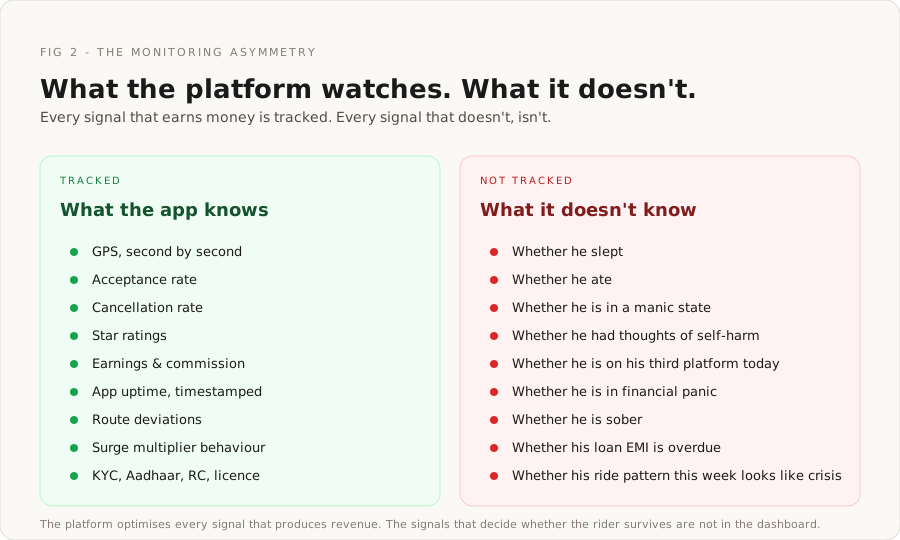
Each of those is a signal that could decide whether the next ride is safe. None of them is in the dashboard.
The seat behind him
A bike taxi is the only paid form of urban transport in India where the passenger is physically against the operator. No cabin. No back seat. No barrier. Her hand is on his shoulder for the duration of the ride. The closeness is not a side effect of the format. It is the format.
Now read the news, in just the last eighteen months.
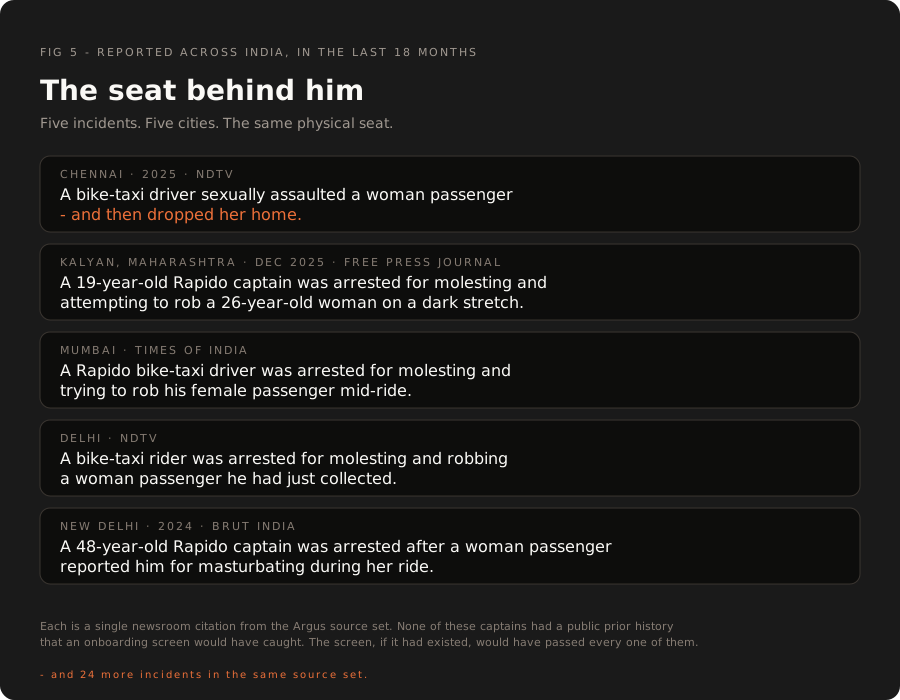
Sit with the first one for a second. "Bike taxi driver sexually assaults woman in Chennai, then drops her home." That is the NDTV headline. The accused captain assaulted his passenger, and then completed the booking. Took her to her door. Closed the trip. The rating prompt would have appeared on her phone before she had found her keys. There is no tab in the platform's interface for what had just happened to her. There is one for thank you and one for report a problem, but neither was designed for the ride she had just survived.
Or sit with the Kalyan case. A nineteen-year-old captain, a twenty-six-year-old woman, a dark stretch she had not chosen because the routing did. He had been a captain for less time than most internships. He cleared an onboarding check that asked for a licence, an RC, and an Aadhaar. The screen, if it had existed, would have passed him. There was nothing yet on him to fail.
A 2024 Indian study by Singh and colleagues found that women in the gig economy carry an anxiety profile "more pronounced" than the male cohort - and that is the women driving, not the women riding. A 2025 Nature paper on the safety of female ride-hailing passengers established that driver words and actions directly shape the passenger's sense of safety, but every intervention the literature studies is what the driver says or does during the ride. Almost no one is asking what the driver brought to the ride.
A psychometric screen at onboarding could not have prevented any of these incidents. None of those captains had a public prior history that an onboarding screen would have caught. They were ordinary men inside an ordinary system, until they weren't. The platform safeguards that do exist - SOS button, share-trip-with-emergency-contact, post-ride rating - are downstream of his state when he accepts the ride. None of them is upstream of it. Downstream is the wrong place to be when his hand is six inches from her face on a moving two-wheeler.
The captain on the other side of it
If you are tempted to read this piece as anti-captain, please don't.
The same source set that produced the cases above also recorded a Rapido captain in Hyderabad attacked at a traffic signal, with three men arrested for it. Another Rapido rider, on a separate booking, was kidnapped, brutally thrashed, and dumped before he was found. The All India Gig Workers Union's 2026 internal survey of its own members reports more than sixty percent showing symptoms of anxiety or depression. The 2024 Amoadu scoping review of commercial drivers worldwide, twenty-seven citations and counting, names this profile - long hours, low control, weak support, low pay - as the most reliable predictor of mental-health deterioration in driving work. He is not the villain in his own life. He is also among the loneliest workers in any organised industry of comparable scale in the country.
The fact that he is also, for some women, a danger, is what makes this hard. Both things are true at once. The women on those bikes are not paying for their convenience with their safety - they are paying for the platform's structural unwillingness to know him as anything more than a row in a database. And the captain who reaches her safely tonight is doing so on no rest, no real meal, no human support, and a phone call from a recovery agent he hasn't returned.
The mental-fitness gap is the thing in the middle. Both seats of the bike are downstream of it.
Sequencing is what does the work
So if mandatory screening doesn't work, and aviation is in retreat, and Brazil's seventy-five-year experiment is inconclusive, and the basic monitoring layer is missing entirely - what would actually move the needle.
The answer that survives the evidence, when you read it end to end, is sequencing. The order of operations is what does the work. Most policy proposals reverse the order, and that is why they fail. Here is how the order needs to run, and why each step is load-bearing for the next.
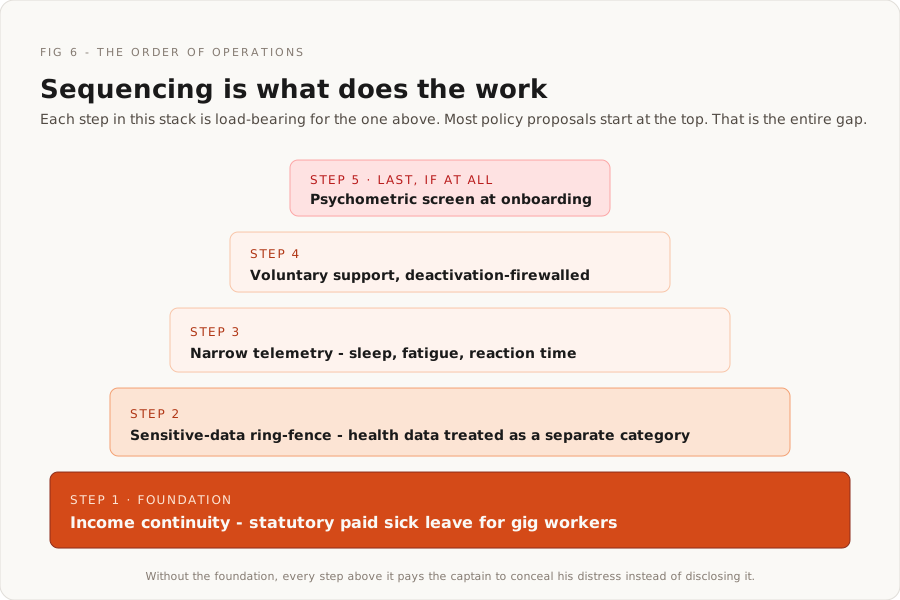
First, income continuity. Statutory paid sick leave for gig workers. The reason the FAA can run a "treatment-permissive" framework - see your doctor, get treated, come back to work - is that pilots have salaries, unions, insurance, and continuity. Indian gig captains have none of those. Without an income floor underneath, every later step in this stack collapses, because every later step requires the captain to admit something that today, admitted, would mean he cannot eat.
Second, sensitive-data protection. India's DPDP Rules, notified in November 2025, do not create a separate sensitive-data category for mental-health information. Anything a screening regime captures today sits one breach away from becoming a deactivation tool. Until that gets ring-fenced, no captain in his right mind should disclose anything to a clinician hired by the platform that pays him.
Third, narrow telemetry, not wide screens. Sleep. Fatigue. Reaction time. The Japanese tachograph studies show these correlate with measurably dangerous driving behaviour. A 2025 preprint shows rapid cognitive testing predicts real-world crash risk. These are validated, low-burden, narrow-construct tools. They sit on a shelf because no one has built them into a gig app.
Fourth, voluntary, deactivation-firewalled support. An assistance channel that the captain can use without it ever influencing his ride allocation. Until uptake is measured, published, and protected, no support layer survives contact with platform incentives.
Fifth - and only fifth - a psychometric screen at onboarding, if at all. The empirical case for this is the weakest layer, the FAA is retreating from it, the Brazilian experience is mixed at best, and the captain population's economic asymmetry breaks the screen.
Most public conversations about this start at step five. They never mention steps one through four. That is the entire gap.
One small thing on your next ride
The reason I wrote this is that I have been thinking about a specific moment.
I book a Rapido. The captain shows up. I climb on. I look at the back of his helmet. I have been doing this for years, and I have never once thought of him as anything other than transport.
He is not transport. He is a person sitting inside a job that is, statistically and structurally, designed to produce the exact failure modes we then blame him for. He is a person whose bank account, his single most legible signal to the platform, can run ₹1.4 crore a day for eight months without an alert. He is a person whose mental state is fully invisible to the system that is, in every other respect, watching him constantly.
The next time you book a ride, do one small thing. Look at his face. Ask his name. Notice him. Not because that fixes anything - it doesn't - but because the gap between what we ask of him and what we know about him is, when you actually see it, one of the strangest invisibilities in modern Indian life.
He is the thing the app doesn't ask.