Your RAG Pipeline Has a Context Problem. Perplexity Just Open-Sourced the Fix.

- Name
- Karan Prasad
Your RAG Pipeline Has a Context Problem. Perplexity Just Open-Sourced the Fix.
A deep technical breakdown of pplx-embed-v1 and pplx-embed-context-v1 - what they are, how they work, why they matter, and what changes for everyone building retrieval systems.
You've been there. You split a 40-page PDF into 512-token chunks. You embed each chunk with whatever model tops the MTEB leaderboard this week. You store the vectors in your favorite DB. And then someone asks a perfectly reasonable question - "What was the company's revenue growth?" - and your pipeline retrieves a chunk that says "Its revenue grew by 3% year over year" with zero mention of which company, which year, or which product line.
The chunk is technically correct. It's also completely useless.
You know the drill that follows. You try overlapping chunks. You add metadata. You bolt on a reranker. You experiment with parent-document retrieval. Maybe you try HyDE or query expansion. Each patch adds complexity, each one helps a little, and none of them fix the root cause: the embedding itself doesn't know what "it" refers to.
On February 26, 2026, Perplexity released four embedding models that attack this problem at its source. Two standard dense models (pplx-embed-v1 at 0.6B and 4B parameters) and two context-aware models (pplx-embed-context-v1 at the same scales) - all MIT-licensed, all with open weights on Hugging Face, and all trained with a novel pipeline that converts Alibaba's Qwen3 decoder into a bidirectional encoder through diffusion pretraining.
The context-aware variant is the interesting one. It embeds document chunks while seeing the entire document, so that each chunk's vector encodes both its local content and its relationship to the surrounding text. And it achieves 81.96% nDCG@10 on ConTEB - the benchmark specifically designed to test this capability - beating Voyage AI's purpose-built commercial model (79.45%) and Anthropic's contextual retrieval approach (72.4%).
Let me walk through what's actually happening under the hood, why it matters, and where it falls short.
The problem, from first principles
Let's state the assumptions clearly before building on them.
Assumption 1: Dense retrieval works by comparing the cosine similarity between a query vector and a set of document vectors. If the document vector doesn't encode the right information, no amount of downstream processing can recover it. This is information theory - you can't retrieve what was never represented.
Assumption 2: When you chunk a document, each chunk becomes an independent input to the embedding model. The model has no idea that chunk 7 came right after chunk 6. It doesn't know that "the company" in chunk 7 refers to "Obvix Labs" mentioned in chunk 3. Every pronoun, every anaphoric reference, every continuation of a multi-paragraph argument - all of it gets severed at chunk boundaries.
Assumption 3: The patches we've built - overlapping windows, rerankers, query expansion, hybrid search - all operate either at query time or post-retrieval. They cannot fix a chunk whose embedding fundamentally lacks the context to match a relevant query. A reranker can re-order candidates, but it can't surface a chunk that was never retrieved in the first place because its vector was decontextualized.
This is the core insight driving pplx-embed-context-v1: if context loss happens at embedding time, fix it at embedding time.
 Figure 1: Standard chunking creates orphaned vectors. Contextual embedding preserves cross-chunk relationships through bidirectional attention during a single forward pass.
What Perplexity actually built
Both model families start from the same foundation: Qwen3 base models at 0.6B and 4B parameters. The training pipeline is where things get interesting.
Stage 1: Turning a decoder into an encoder via diffusion
Qwen3, like GPT and Llama, is a causal language model - each token can only attend to tokens before it (left-to-right). This is great for text generation but terrible for embeddings, because the last token can't "see" the first token's contribution to meaning.
Perplexity's solution: diffusion-based continued pretraining. They disable the causal attention mask, randomly mask tokens, and train the model to reconstruct them using full bidirectional context - the same denoising objective used in diffusion models, but applied to text. This runs for approximately 250 billion tokens across 30 languages (roughly half English from FineWebEdu, half non-English from FineWeb2).
The result: a Qwen3 model that now uses full bidirectional attention. Each token representation incorporates information from the entire input, not just preceding tokens. Their ablation studies show this diffusion pretraining yields about a 1 percentage point improvement on retrieval tasks compared to naively removing the causal mask - small but consistent, and it compounds across the later training stages. (arXiv:2602.11151)
Stage 2: Contrastive pair training
Standard contrastive learning. Query-document pairs, InfoNCE loss, in-batch negatives. But with a useful detail: they apply a similarity-based mask that prevents near-duplicate samples within a batch from acting as false negatives. If two documents in the same batch are 95% similar, the model won't be penalized for embedding them close together - because they should be close.
Training proceeds in phases: English-only first, then cross-lingual, then fully multilingual. The final data mix is 65.6% English, 26.7% multilingual, 6.7% cross-lingual, and 1% code.
Stage 3: Where the two model families diverge
This is where the pipeline branches.
Branch A → Contextual training produces pplx-embed-context-v1. The model learns chunk-level semantics relative to the full document through a dual loss:
- In-sequence contrast: chunks from the same document are contrasted against each other, teaching the model to differentiate sections within a single document
- In-batch contrast: chunks from different documents are contrasted, teaching standard cross-document discrimination
Both losses operate at chunk granularity and document granularity simultaneously. There's also a scheduled weighting scheme - the model starts focused on local chunk semantics, then gradually incorporates document-level learning to avoid catastrophic forgetting of what it learned in Stage 2.
Branch B → Triplet training uses mined hard negatives (documents that are similar but not relevant) alongside positives. This sharpens the model's ability to discriminate between documents that look alike but answer different questions.
Stage 4: SLERP merge → pplx-embed-v1
The final pplx-embed-v1 model is neither the contextual checkpoint nor the triplet checkpoint. It's a Spherical Linear Interpolation (SLERP) merge of both - blending their weights along the curved surface of the parameter hypersphere. This combines the contextual model's document awareness with the triplet model's fine-grained discrimination, without additional training.
This is clever engineering. SLERP merging has been used in the open-source LLM community for model souping, but applying it to produce a standard embedding model from a contextual and discriminative checkpoint is a novel application.
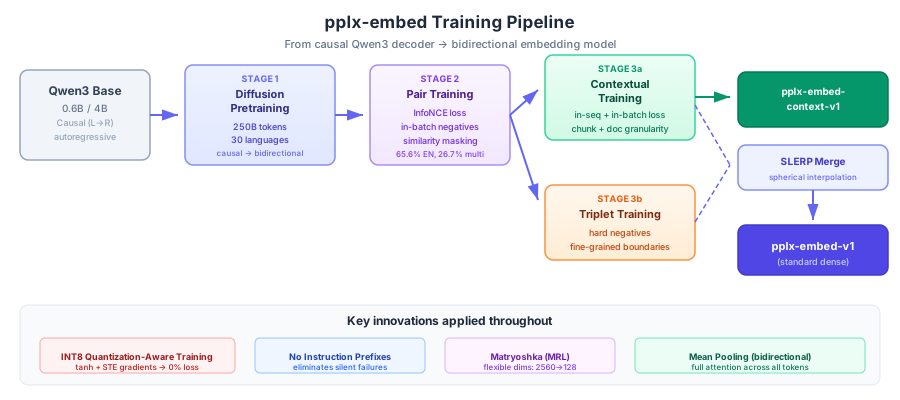 Figure 2: The complete training pipeline. Key insight: the final pplx-embed-v1 standard model inherits document awareness from the contextual branch via SLERP merging.
How contextual embedding actually works at inference time
Here's where rubber meets road. When you use pplx-embed-context-v1, the inference flow is fundamentally different from standard embedding.
Standard model (pplx-embed-v1):
# Each chunk embedded independently
embedding_1 = model.encode("Berlin is the capital of Germany.")
embedding_2 = model.encode("Its more than 3.85M inhabitants make it...")
# embedding_2 has NO idea what "its" refers to
Contextual model (pplx-embed-context-v1):
# All chunks from one document, embedded together
chunks = [
    "Berlin is the capital of Germany.",
    "Its more than 3.85M inhabitants make it...",
    "The city is also a major centre of..."
]
# Model receives: [chunk1] [SEP] [chunk2] [SEP] [chunk3]
# Full bidirectional attention across ALL chunks
# Output: 3 separate vectors, each context-aware
embeddings = model.encode_contextual(chunks)
Under the hood, all chunks are concatenated with separator tokens and passed through the bidirectional encoder in a single forward pass. Because every token attends to every other token (that's what the diffusion pretraining enabled), the representation for "its" in chunk 2 incorporates the information that "Berlin" appeared in chunk 1. Mean pooling is then applied independently to each chunk's token span, producing separate embedding vectors.
At query time, you use the standard pplx-embed-v1 to embed the query - the contextual model is only used during document ingestion. This is important: the asymmetry means your query-side latency is identical to any standard embedding model.
The competitive landscape: three ways to solve context loss
Perplexity's approach didn't emerge in a vacuum. It synthesizes ideas from three distinct prior approaches, each with different tradeoffs.
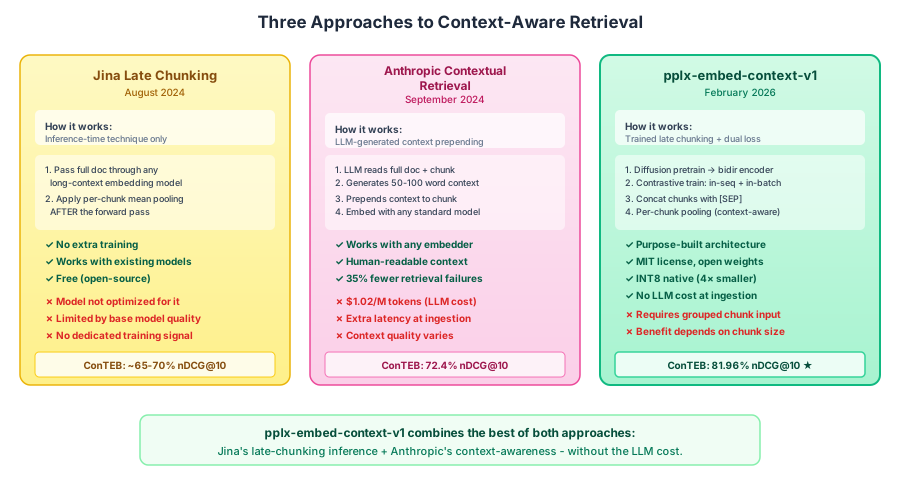 Figure 3: Jina's late chunking is free but untrained. Anthropic's approach is effective but expensive. Perplexity combines trained architecture with late-chunking inference - at zero LLM cost.
Jina's late chunking (August 2024)
Jina AI introduced "late chunking" as a pure inference-time technique. The idea: take any long-context embedding model, pass the full document through it, and then apply per-chunk pooling to the output representations. No training modifications, no additional cost - just change the order of operations from "chunk then embed" to "embed then chunk."
It works. Their experiments showed consistent improvements on BeIR datasets, with gains scaling with document length. But the base model was never trained for this use case. It doesn't have a dedicated loss function teaching it to produce distinct, useful chunk representations within a shared context. The approach is elegant and zero-cost, but it leaves performance on the table. (Jina AI Blog)
Anthropic's contextual retrieval (September 2024)
Anthropic took the opposite approach. Instead of modifying the embedding model, they modify the input. An LLM (Claude 3 Haiku) reads the entire document alongside each chunk and generates a 50–100 word context summary, which is prepended to the chunk before embedding with any standard model.
The results were impressive - a 35% reduction in retrieval failure rate, climbing to 49% when combined with contextual BM25. But it costs $1.02 per million document tokens at the LLM inference step, adds latency at ingestion time, and the quality depends entirely on the LLM's summarization ability. For large-scale indexing (millions of documents), this gets expensive fast. (Anthropic Blog)
pplx-embed-context-v1 (February 2026)
Perplexity's approach combines the structural insight from Jina (late chunking at inference) with the training rigor that Jina lacked, while avoiding Anthropic's LLM cost entirely. The model is purpose-built for contextual chunk embedding through the dual in-sequence/in-batch contrastive loss.
The research backing this comes from the ConTEB benchmark paper (EMNLP 2025), which introduced the InSeNT training methodology. The paper's key finding: having both in-sequence and in-batch negatives during training is "absolutely crucial" for effective context-aware embedding - using only one or the other significantly degrades performance. Perplexity's training pipeline directly implements this.
Benchmark numbers - and what to actually trust
Let me be direct about the benchmark situation, because it's nuanced.
What Perplexity reports (and can be independently verified)
On MTEB Multilingual v2 retrieval (nDCG@10), the 4B INT8 model scores 69.66%, beating Qwen3-Embedding-4B (69.60%) and Google's gemini-embedding-001 (67.71%). These are specifically retrieval subset scores - Perplexity has not published overall MTEB averages across all eight task types (classification, clustering, STS, etc.), which suggests these models are retrieval-specialized rather than general-purpose.
On ConTEB (context-aware retrieval), pplx-embed-context-v1-4B achieves 81.96% nDCG@10 - a clear lead over Voyage-context-3 (79.45%) and a massive gap over non-contextual approaches. This benchmark was specifically designed to test whether models preserve cross-chunk context, so strong performance here directly validates the architectural claims.
On BERGEN (end-to-end RAG), pplx-embed-v1-4B outperforms Qwen3-Embedding-4B on 4 of 5 QA tasks. The 0.6B model outperforms the larger Qwen3-4B on 3 of 5 - which is remarkable given the 7× size difference.
What Perplexity reports (but can't be independently verified)
The most dramatic numbers come from internal benchmarks. On PPLXQuery2Query (2.4M corpus, 115K real user queries), the 4B model hits 73.5% Recall@10 versus Qwen3-4B's 67.9% - a 5.6 point gap. On PPLXQuery2Doc (30M documents), 91.7% Recall@1000 versus 88.6%. These are proprietary datasets derived from Perplexity's production search engine, so they can't be independently reproduced. They may reflect real-world performance better than academic benchmarks, or they may be cherry-picked. Take them as directional signal, not gospel.
What independent testers found
Kirk Ryan's evaluation compared pplx-embed against Ollama/Qwen3 on a 72-document news corpus and found pplx-embed produced fewer false positives and better semantic calibration. But - and this is important - his test of the contextual model with 512-token chunks showed no measurable benefit over the standard model. This suggests the contextual model's advantages require either shorter chunks (where more context is lost) or documents with high cross-chunk dependency (legal docs, technical specs, research papers) to manifest clearly. If your chunks are already self-contained paragraphs, the contextual model may not help.
Dennis Feyerabend's evaluation on a bird-species retrieval task found perfect 7/7 accuracy with 40% better semantic separation between dissimilar queries compared to MiniLM.
Two design decisions worth understanding deeply
Native INT8 quantization-aware training
Most models are trained in FP32/FP16 and then quantized post-hoc, which introduces some quality loss. Perplexity trains with INT8 quantization in the loop - during both forward and backward passes at every training step.
Here's how it works: after mean pooling, embeddings are passed through a tanh activation (bounding values to [-1, 1]), then scaled and rounded to INT8 range. Because rounding is non-differentiable, they use Straight-Through Estimation (STE) to pass gradients through the quantization step as if it were an identity function. The model learns representations that are inherently robust to quantization noise.
The result: INT8 embeddings with zero measurable quality loss versus FP32. Binary embeddings (1-bit, 32× storage reduction) degrade by less than 1.6 percentage points for the 4B model. For anyone running a vector DB at scale, this means 4× less storage and memory for INT8 with no accuracy trade-off - or 32× less if you can tolerate the binary degradation.
No instruction prefixes - and why that's a feature, not a limitation
OpenAI's models need "Represent this document for retrieval:". Qwen3 needs "Instruct: [task]\nQuery: [text]". BGE needs "Represent this sentence for searching relevant passages:". Every model has its own magic prefix, and getting it wrong silently degrades quality without any error message.
Perplexity deliberately chose to skip instruction tuning. Their ablation shows it adds only 2–3% on benchmarks while introducing a whole class of silent production failures:
- Developer forgets the prefix during indexing but includes it at query time → asymmetric embeddings, degraded retrieval
- Different wrapper libraries use different default prefixes → inconsistent results across environments
- Prefix changes between model versions → embeddings become incompatible after updates
No prefix means no silent failures. Embed your text. Get your vector. Done.
Model specs at a glance
| pplx-embed-v1 | pplx-embed-context-v1 | |
|---|---|---|
| Purpose | Standard dense retrieval (queries, passages) | Context-aware chunk embedding (RAG pipelines) |
| Sizes | 0.6B, 4B | 0.6B, 4B |
| Embedding dim | 1024 (0.6B) / 2560 (4B) | 1024 (0.6B) / 2560 (4B) |
| Max tokens | 32,768 | 32,768 |
| Quantization | INT8 native, binary supported | INT8 native, binary supported |
| MRL | Yes (dims down to 128) | Yes (dims down to 128) |
| License | MIT | MIT |
| Instruction prefix | None needed | None needed |
| Similarity | Cosine (unnormalized output) | Cosine (unnormalized output) |
| HF weights | 0.6B / 4B | 0.6B / 4B |
API pricing (docs.perplexity.ai):
| Model | Price per 1M tokens |
|---|---|
| pplx-embed-v1-0.6B | $0.004 |
| pplx-embed-v1-4B | $0.020 |
| pplx-embed-context-v1-0.6B | $0.010 |
| pplx-embed-context-v1-4B | $0.050 |
For reference, OpenAI's text-embedding-3-large costs $0.13/M tokens. The 0.6B standard model is 32× cheaper.
What we were doing wrong - and what changes now
Let me frame this as concretely as possible.
Before pplx-embed-context-v1
The standard RAG pipeline treated embeddings as a solved problem. Pick a model from MTEB, embed your chunks, store in a vector DB, done. When retrieval quality was poor, the instinct was to fix it downstream:
- Tune chunk sizes - smaller chunks for precision, larger for context. But you can't have both.
- Add overlapping windows - preserve boundary context. But only local overlap, and storage doubles.
- Bolt on rerankers - cross-encoders like Cohere Rerank or bge-reranker-v2. Improves ranking, can't fix recall.
- Hybrid search - combine BM25 with dense retrieval via reciprocal rank fusion. Helps with keyword matching, doesn't solve decontextualization.
- Query expansion / HyDE - LLM generates hypothetical answers to improve query-side alignment. Query-side fix for a document-side problem.
- Parent-document retrieval - retrieve the chunk, return the parent document. Works, but you lose the specificity of chunk-level retrieval.
Every single one of these is a patch applied after the context has already been lost. They're treating symptoms, not the disease.
What changes
Context-aware embeddings fix the problem at its source. The vector itself encodes cross-chunk context, so downstream patches become less critical:
- Chunking strategy becomes less fragile. You can chunk more aggressively (shorter chunks) without losing document-level signals, because the embedding preserves them.
- Reranker marginal value decreases. If first-stage retrieval already captures context-dependent matches, there are fewer "right document, wrong chunk" failures for the reranker to fix. (You may still want a reranker - Anthropic found 67% failure reduction when combining contextual embeddings with reranking - but the dependency is weaker.)
- Overlapping windows may become unnecessary. The whole point of overlap is to preserve boundary context. If the embedding model already sees the full document, overlap adds storage without adding information.
The caveat
Kirk Ryan's independent evaluation found no measurable benefit from the contextual model with standard 512-token chunks on a news corpus. This is consistent with the theory: if your chunks are already self-contained paragraphs with clear subjects and referents, there's no context to recover. The contextual model shines when:
- Chunks are short (128–256 tokens) and frequently reference earlier content
- Documents are highly cross-referential (legal contracts, technical docs, research papers)
- Multi-hop questions require synthesizing facts from multiple sections
If your corpus is a collection of standalone FAQ entries, the standard pplx-embed-v1 is probably all you need.
How this fits the bigger picture in embeddings
The embedding landscape has been shifting fast. Let me map where pplx-embed sits relative to the major families and what trajectories are emerging.
The BGE/E5/GTE era (2023–2024) was defined by BERT-scale encoders (100M–335M params) fine-tuned with contrastive learning. BGE-large-en-v1.5 from BAAI was the workhorse - MIT-licensed, 335M parameters, 1024 dimensions, reliable. E5-large-v2 from Microsoft was its main rival. These models democratized dense retrieval but topped out around 54–56% on BEIR and couldn't handle documents longer than 512 tokens.
The LLM-as-embedder era (2024–2025) started with E5-Mistral using a 7.1B decoder with synthetic training data, then NV-Embed-v2 (7.8B) pushed MTEB averages to 72%. Google and Alibaba brought their own large models. The insight: bigger pretrained models capture richer semantics, even when repurposed as encoders. But they were expensive to run and mostly API-only or non-commercially licensed.
The quantization + context era (2026) is where pplx-embed sits. The key contributions aren't just "a better model" - they're structural:
- Diffusion-based causal-to-bidirectional conversion is a genuinely new technique that outperforms naive mask removal
- Native quantization-aware training achieves lossless INT8 compression - not post-hoc, but during training
- Contextual embedding with trained late chunking combines the architecture-level approach (Jina) with dedicated training (InSeNT/ConTEB)
- MIT license at 0.6B and 4B hits a sweet spot: small enough to self-host on consumer GPUs, large enough to match models 6–10× bigger
The trajectory is clear: embedding models are getting smarter about the structure of documents, not just the content of individual passages. The next frontier is probably multi-modal contextual embeddings (images, tables, and text chunks with shared context), but for text retrieval, pplx-embed represents the current state of the art for open-source.
Practical migration guide
If you're running a RAG pipeline today and want to evaluate pplx-embed, here's a concrete path.
For the standard model (drop-in replacement)
If you're currently using text-embedding-3-small, bge-large-en-v1.5, or any SentenceTransformers-compatible model, switching to pplx-embed-v1-0.6b is a one-line change:
from sentence_transformers import SentenceTransformer

# Before
# model = SentenceTransformer("BAAI/bge-large-en-v1.5")

# After
model = SentenceTransformer(
    "perplexity-ai/pplx-embed-v1-0.6b",
    trust_remote_code=True
)

embeddings = model.encode(["your text here"])
Important: use cosine similarity, not dot product. The embeddings are unnormalized.
Note: trust_remote_code=True is required because the model uses a custom architecture class (bidirectional_pplx_qwen3). This means the model card contains executable Python code that runs on your machine. Review the model code on HF before running in production if you're security-conscious. (Given our shared interest in security - always review trust_remote_code before enabling it.)
For the contextual model (requires restructured ingestion)
The contextual model requires you to group chunks by document before embedding:
# Via Perplexity API
import requests

response = requests.post(
    "https://api.perplexity.ai/v1/contextualizedembeddings",
    headers={"Authorization": f"Bearer {API_KEY}"},
    json={
        "model": "pplx-embed-context-v1-0.6b",
        "input": [
            # Each inner list = chunks from ONE document
            ["chunk 1 of doc A", "chunk 2 of doc A", "chunk 3 of doc A"],
            ["chunk 1 of doc B", "chunk 2 of doc B"]
        ]
    }
)
The inner array structure is non-negotiable - the model needs to see all chunks from a document together to provide cross-chunk context.
Self-hosting with TEI
For self-hosted deployment via Text Embeddings Inference (v1.9.2+):
docker run --gpus all -p 8080:80 \
  ghcr.io/huggingface/text-embeddings-inference:latest \
  --model-id perplexity-ai/pplx-embed-v1-0.6b \
  --max-batch-tokens 32768 \
  --max-client-batch-size 32
The 0.6B model is ~1.2 GB on disk. For reference, all-MiniLM-L6-v2 is ~90 MB - so this is a 13× size increase for substantially better retrieval quality. If you're running on a machine with ≥4GB VRAM, the 0.6B model should fit comfortably.
Where this falls short (honest assessment)
No model is perfect, and I want to flag the limitations clearly:
No overall MTEB scores published. Perplexity only reports retrieval-subset performance. If you need a general-purpose embedding model for classification, clustering, STS, and retrieval, these models may underperform models like NV-Embed-v2 that optimize across all eight MTEB task types.
Contextual benefit is workload-dependent. Kirk Ryan's null result with 512-token chunks is a real data point. If your documents are collections of self-contained paragraphs (blog posts, FAQs, product descriptions), the standard model may be all you need.
Built on Qwen3, not original architecture. The base model is Alibaba's - Perplexity's contribution is the training pipeline. This means the model inherits Qwen3's strengths and weaknesses in tokenization, multilingual coverage, and long-context handling.
Internal benchmarks are non-reproducible. The most impressive numbers (PPLXQuery2Query, PPLXQuery2Doc) come from proprietary datasets. They may be representative of real-world performance or they may be optimistically selected. Academic benchmarks (MTEB, ConTEB, BERGEN) are reproducible and confirm strong performance, but the gaps are smaller than the internal numbers suggest.
No established fine-tuning workflow yet. While the MIT license permits fine-tuning, there's no published guide for domain adaptation. SentenceTransformers should support it, but this is untested territory.
Bottom line
For indie developers and small teams building RAG systems, here's how I'd think about this:
If you're starting a new RAG pipeline today, use pplx-embed-v1-0.6b as your default embedding model. It matches or beats models 7× its size on retrieval benchmarks, costs $0.004/M tokens via API, and requires no instruction prefixes. It's a strict upgrade over bge-large-en-v1.5 or text-embedding-3-small with no additional complexity.
If you're building a RAG system over long, cross-referential documents (legal contracts, research papers, technical documentation), evaluate pplx-embed-context-v1 with your actual corpus. Benchmark it against the standard model with your real queries. The contextual model adds ingestion complexity (grouped chunk input) but may significantly improve recall for queries that depend on cross-chunk context.
If you're happy with your current embedding model's retrieval quality, don't switch for the sake of switching. Benchmark first. The improvements over Qwen3 and Gemini are real but modest on public benchmarks (fractions of a percentage point on MTEB retrieval). The biggest gains are on context-dependent retrieval and web-scale queries - if that's not your bottleneck, your effort is better spent elsewhere.
The embedding landscape just got a legitimate open-source contender for context-aware retrieval. For those of us building retrieval systems, that's the real story here - not another SOTA claim on a leaderboard, but a fundamentally different approach to an old problem, with open weights and an MIT license.
All benchmark numbers cited in this post are from Perplexity's official research blog, the arXiv paper (2602.11151), ConTEB/InSeNT (EMNLP 2025), the Hugging Face model cards, and independent evaluations by Kirk Ryan and Dennis Feyerabend. Pricing from the Perplexity Embeddings API docs.
- Karan Prasad (@thtskaran)